Chapter 1
Evolutionary Anxiety
From survival alarms to the need to belong, this chapter explores why vigilance can protect us—and why an ancient alarm system can feel overwhelming in modern life.
The Universal Roots of Human Anxiety
Before we have words, we have a need for safety.
From the newborn’s cry to the adult’s search for meaning, Anxious at Birth explores anxiety as a lifelong human companion. Marcus R. Hatt brings together lived experience, research, and philosophy to ask how safety helps us connect, recover, and grow.
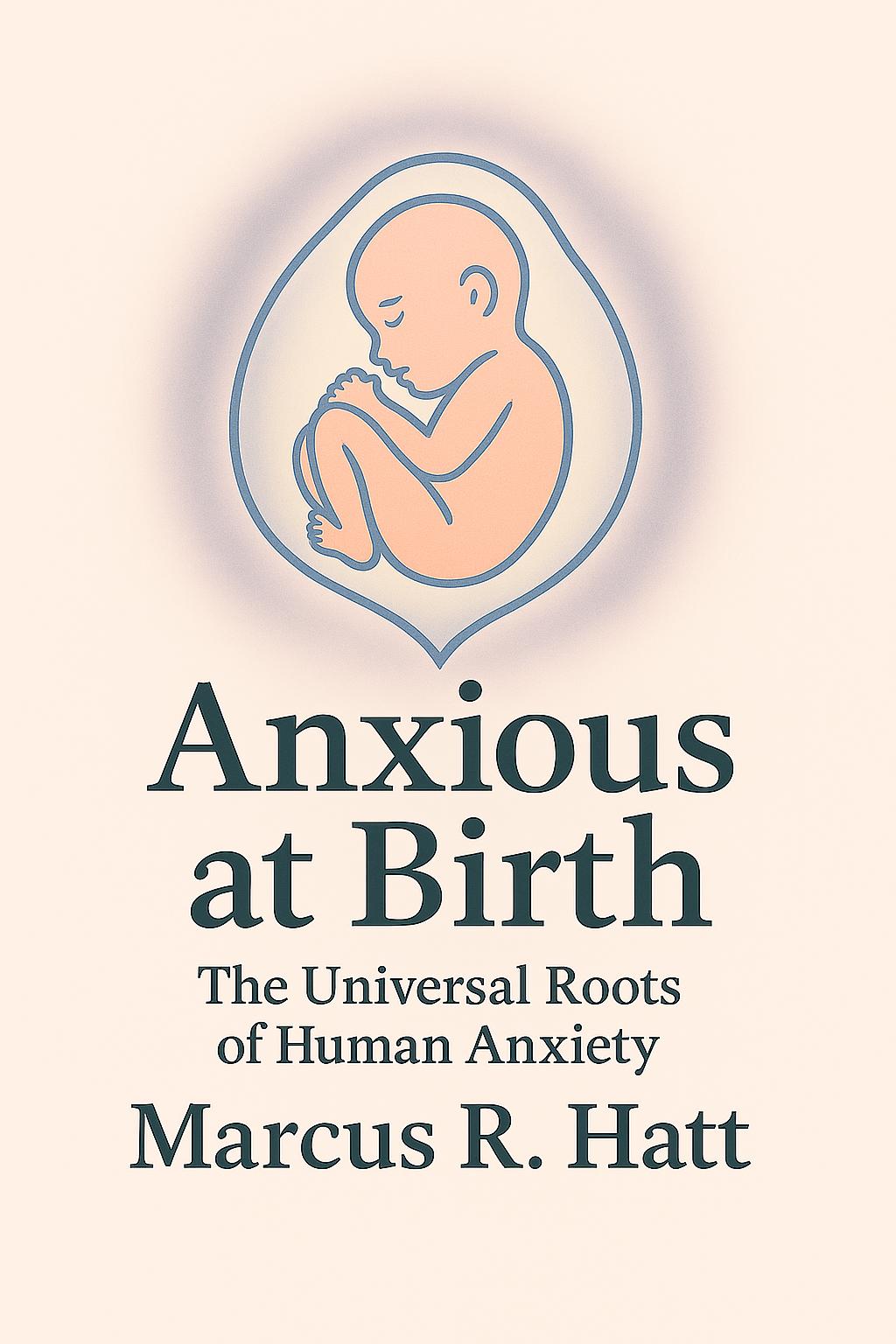
This book explores normal anxiety as part of being human.
This book is not about eliminating anxiety. It is about reimagining it.
What if anxiety is more than an intruder in our lives? Anxious at Birth follows the search for safety through evolution, the brain, family histories, and the relationships that shape us. It invites readers to approach anxiety with curiosity and compassion rather than self-blame.
This book explores normal anxiety as part of being human. It does not challenge the DSM-5, redefine its diagnostic categories, or dismiss anxiety disorders and the distress they can cause. Its focus is the everyday experience of anxiety across the lifespan.
Drawing on neuroscience, developmental psychology, philosophy, and personal experience, Marcus explores both anxiety’s protective role and the suffering it can cause. His idea of an “anxious system” brings these perspectives together; it does not replace clinical definitions or suggest that anxiety disorders should go untreated. Safety is a thread throughout the book, with the Safety Architecture Model explored in depth in Chapter 22.
Chapter 1
From survival alarms to the need to belong, this chapter explores why vigilance can protect us—and why an ancient alarm system can feel overwhelming in modern life.
Chapter 2
A journey through threat detection, the HPA axis, cortisol, and regulation, alongside the roles of movement, creativity, purpose, and another person’s steady presence.
Chapter 3
Family stories, learned vigilance, prenatal conditions, and emerging epigenetic research offer different ways to understand inherited patterns. The chapter distinguishes established findings from possibilities still under investigation.
Chapter 4 · Ages 0–2
The first cry, the secure base, and everyday moments of comfort and repair reveal how trust develops through relationship. Reliable care matters more than a perfect response every time.
Chapter 5 · Ages 2–4
From “I can do it myself” to the monster under the bed, this chapter explores how growing independence and imagination bring new anxieties. Empathy, predictable routines, and steady companionship help children build confidence while keeping safety within reach.
From the Introduction
Begin with the Introduction and explore Chapters 1–5. A different passage is featured each day; all six are always available below.
This book explores normal anxiety as part of being human. It does not redefine anxiety as understood by the DSM-5, nor does it dismiss clinical categories or diagnoses.
Today’s passage: Introduction
Consider the 7-year-old child standing at the doorway of a classroom on the first day of school. Her stomach is knotted, her palms are damp, and she scans the room for a familiar face. Anxiety here is not pathology—it is her system preparing her to connect, to adapt, to find belonging. When she spots a friend and takes a seat, anxiety has done its work as both a challenge and a guide.
Marcus R. Hatt, Anxious at Birth, Introduction.
An evolutionary interpretation of everyday anxiety.
When we step back and consider anxiety through the evolutionary lens, a striking truth emerges: anxiety is not a flaw in human design, but one of its most essential features. The nervous anticipation we feel before a challenge, the unease in the face of uncertainty, the vigilance that keeps us alert: these are not accidents. They are the same forces that allowed our ancestors to endure famine, fight off predators, and navigate the treacherous path of survival.
Marcus R. Hatt, Anxious at Birth, Chapter 1 · Evolutionary Anxiety.
Hatt’s developmental interpretation, drawing on Erikson. The passage begins with the paired tensions named in the chapter.
Across childhood, this rhythm shows up as paired tensions: dependence and autonomy, imagination and reality, rebellion and belonging. Erikson described growth itself as a series of such polarities 11. Anxiety signals imbalance between them; it’s the body’s call for recalibration. A caregiver’s sensitive presence answers that call, co-regulating the child back toward center, and guiding the pendulum until the child can eventually hold it alone.
Marcus R. Hatt, Anxious at Birth, Chapter 2 · The Anxious System in the Brain.
11. Erikson, E. H. (1993). Childhood and Society. W. W. Norton.
This chapter looks at anxiety as something we inherit, not only as something we feel. Passed down through generations, anxiety is like a thread woven into our lives, not a flaw but a sign of our ancestors’ survival. We explore its roots with the same compassion Carl Rogers brought to his work: the belief that people move toward wholeness when their history is met with understanding rather than judgment. 1
Freedom feels like falling, until the moment you learn to call it flight. To inherit anxiety, then, is to inherit not just wounds, but wisdom: the raw material either can be built from, depending on what happens next.
Marcus R. Hatt, Anxious at Birth, Chapter 3 · Generational Anxiety.
Selected passages from the chapter opening and Section 5, “Anxiety as Adventure, From Past to Present.”
1. Rogers, C. R. (1961). On becoming a person: A therapist’s view of psychotherapy. Houghton Mifflin.
During the latter half of the first year, many infants begin showing greater wariness toward unfamiliar people. A baby hides her face when a new adult leans too close. This reaction, once seen as shyness, is actually evidence of a maturing brain. The infant now distinguishes familiar from unfamiliar, using the caregiver’s face as a social compass. Bowlby saw this as adaptive vigilance, anxiety keeping the child near protection. 12, 23 In Ainsworth’s Strange Situation, securely attached infants generally sought and accepted comfort from the caregiver following separation. 13 This wariness is not pathology; it is discernment in its earliest form.
Marcus R. Hatt, Anxious at Birth, Chapter 4 · Survival and Attachment Anxiety.
12. Bowlby, J. (1982). Attachment and loss: Vol. 1. Attachment (2nd ed.). Basic Books. (Original work published 1969)
23. Bowlby, J. (1973). Attachment and loss: Vol. 2. Separation: Anxiety and anger. Basic Books.
13. Ainsworth, M. D. S., Blehar, M. C., Waters, E., & Wall, S. (1978). Patterns of attachment: A psychological study of the Strange Situation. Lawrence Erlbaum.
The author’s synthesis of the developmental theories discussed in this chapter.
Across the theoretical traditions surveyed in this chapter runs one enduring insight: anxiety signals potential. It is the friction of expansion, of a self reaching past what it can yet manage while the ground beneath it holds. Growth repeatedly introduces anxiety because expansion brings uncertainty; without containment, there is no secure foundation from which to grow. When caregivers balance freedom with structure, imagination with reality, they convert anxiety into mastery.
Marcus R. Hatt, Anxious at Birth, Chapter 5 · Control and Magical Thinking Anxiety.
Marcus Hatt is a school counselor, writer, and independent publisher whose work explores the intersections of psychology, philosophy, and lived experience.
With a Master's degree in School Counseling from Assumption University, he has spent his career supporting young people and families navigating anxiety, resilience, and personal growth.
Born in Belfast in 1970 during the height of The Troubles, his early experiences shaped a lifelong interest in how fear and resilience travel across generations.
He founded First Cry Press and lives in Massachusetts with his wife and children.

Marcus R. Hatt with his family.
Safety is a thread throughout Anxious at Birth and is explored in depth in Chapter 22. In the Safety Architecture Model (SAM), Marcus R. Hatt proposes that safety is an ongoing regulatory condition, shaped by four interacting domains, that influences how reliably we can learn, connect, create, and plan ahead.
Safety here does not mean constant comfort or a life without challenge. The model asks what helps us remain open to uncertainty and recover after difficulty. It proposes that supportive conditions can make room for exploration and growth, even when our hearts are racing.
Being able to move through activation and recover, rather than remaining caught in alarm.
Finding coherence between how we understand ourselves and what our bodies are telling us.
Experiencing others as dependable, responsive, and non-threatening, with support we can draw on.
Having predictability in our surroundings, routines, housing, and the institutions we rely on.
SAM predicts that instability across several domains can have a disproportionate effect, beyond simply adding up each source of strain.
SAM predicts that rebuilding stability after sustained defensive responding requires more support than maintaining stability in the first place.
SAM proposes that sufficient safety supports productive challenge: the ability to experience uncertainty as an invitation to explore rather than a persistent threat.
The Safety Architecture Model (SAM) is a theoretical framework submitted to Review of General Psychology for consideration. Its ideas remain open to scholarly evaluation and further research.
Publication of Anxious at Birth is planned for June 2027, with availability through major retailers and independent bookstores.
Purchase links will be added as they become available.
Enter your email to request news about the book’s release. Your request is sent to Marcus’s inbox; this form does not automatically subscribe you to a mailing list.
Questions, feedback, or media inquiries? Reach out to us.
This site is for informational purposes only and does not provide medical or mental-health advice.